
Best China Drum Tilter Manufacturer for Global Buyers?
Choosing the best China drum tilter manufacturer for global buyers requires more than comparing prices. A reliable drum tilter should handle daily movement safely, steadily, and with minimal operator strain. Buyers must examine rated capacity, drum size compatibility, turning control, frame strength, and surface protection. Small details matter. A loose clamp can damage a drum. Poor wheel design can slow warehouse work.
This guide introduces practical ways to evaluate Chinese manufacturers before placing an international order. It considers factory experience, production capability, inspection procedures, engineering support, and communication quality. Product drawings, load tests, material records, and operating instructions can reveal more than polished product photos. Buyers should also request clear information about packaging, spare parts, warranty terms, and delivery arrangements. These factors often affect the real cost of ownership.
The “best” supplier is not always the largest or cheapest company. It should match the buyer’s working environment, drum materials, handling frequency, and safety expectations. A manufacturer serving chemical, food, or industrial facilities may need different design features for each application. Stainless steel construction, custom clamps, or improved corrosion resistance may be necessary. However, customization can introduce delays or unexpected costs. That risk deserves honest discussion.
Some product pages make strong claims without showing enough evidence. That is a warning sign. This article offers a balanced framework for comparing manufacturers, checking technical documents, and testing communication before purchase. It also highlights common evaluation gaps that experienced buyers may overlook. A careful decision begins with useful questions, verified details, and realistic expectations.
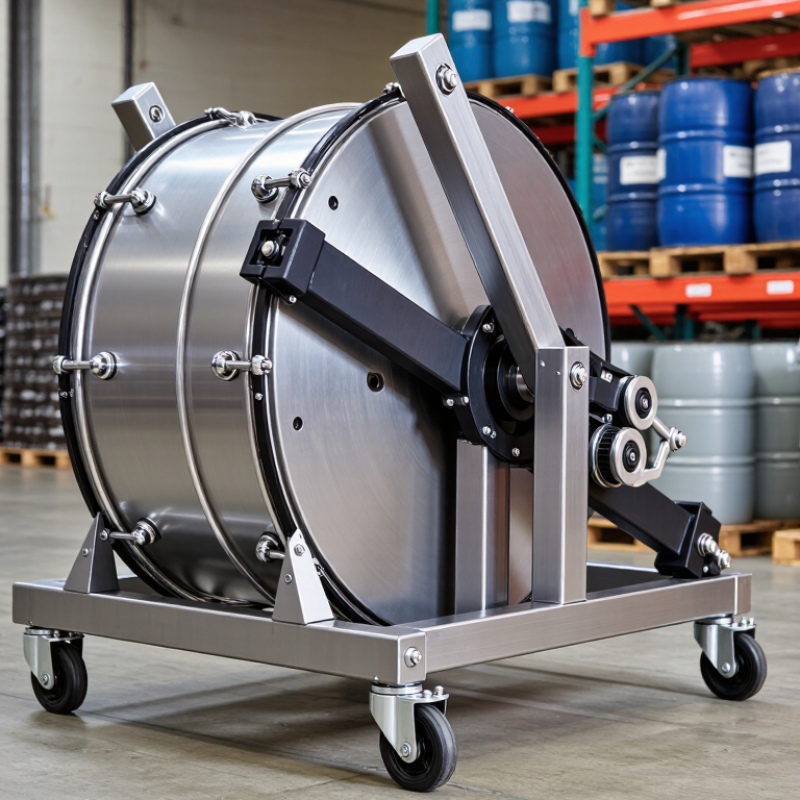
What Is a China Drum Tilter and How Does It Work?
A China drum tilter is material-handling equipment designed to lift, secure, and rotate industrial drums. It commonly handles steel, plastic, or fiber containers. The machine may use hydraulic power, electric drive, or a manual control system. Its clamp or cradle holds the drum during movement. Some models rotate containers through 180 or 360 degrees.
The operator positions the tilter beside a drum and adjusts the gripping assembly. Once the clamp contacts the container, pressure must be checked before lifting. The powered mechanism then raises the drum and moves it toward the discharge point. A geared rotation system controls the turning speed. Smooth rotation helps reduce splashing, sudden impact, and operator strain. In practical warehouse use, drum diameter and rim shape strongly affect gripping stability. Small differences matter.
A capable Chinese manufacturer should provide load charts, operating instructions, inspection records, and clear spare-parts information. Factory testing should examine clamp strength, brake performance, hydraulic leakage, and emergency stopping. Buyers should also verify rated capacity under real drum sizes, not only the maximum advertised load. No design is perfect. Poorly adjusted clamps can still damage containers or allow movement. That weakness deserves attention during evaluation. Reliable suppliers explain maintenance intervals and offer technical support across different working environments. They should also provide consistent documentation for international transport, installation, and operator training.
Best China Drum Tilter Manufacturer for Global Buyers? - What Is a China Drum Tilter and How Does It Work?
Technical reference table for selecting a drum tilter by drum format, load capacity, operating method, safety requirements, and international shipping considerations.
| Data Dimension | Typical Specification | What It Means for Global Buyers | Selection or Verification Point |
|---|---|---|---|
| Basic Function | Lift, hold, rotate, and discharge a drum | A drum tilter reduces manual handling when a filled drum must be positioned, tipped, or emptied. | Confirm whether the unit is designed for lifting only, controlled tilting, or both operations. |
| Common Drum Capacity | Approximately 200 L / 55 US gal | This is a widely used industrial drum size for oils, chemicals, food ingredients, and liquid raw materials. | Check compatibility with the actual drum diameter, height, rim profile, and material. |
| Typical Drum Diameter | Approximately 560–610 mm | The gripping frame, cradle, or clamp must accommodate the outside diameter of the drum. | Measure the filled drum, including ribs, hoops, labels, and protective rings. |
| Typical Drum Height | Approximately 850–950 mm | Drum height affects the required lifting stroke, center of gravity, and discharge clearance. | Allow additional space for the lid, bung fittings, and any pallet or transport base. |
| Rated Load Capacity | Commonly 300–500 kg; heavier designs may exceed 500 kg | The rating must cover the complete filled drum, attachment, and any accessories carried by the lifting mechanism. | Select a rated capacity above the maximum gross drum weight, not only the liquid weight. |
| Operating Methods | Manual, hydraulic, electric-hydraulic, or fully electric | Manual models suit lower duty cycles, while powered models improve productivity and reduce operator effort. | Compare daily drum quantity, lifting frequency, available power, and required positioning accuracy. |
| Tilting Range | Typically 90° to 180°; some designs offer continuous rotation | A 90° tilt can support controlled pouring, while 180° rotation can turn a drum completely upside down. | Verify the required discharge angle and whether the rotation is manual, mechanical, or powered. |
| Rotation Control | Locking positions, geared rotation, or powered variable-speed rotation | Controlled rotation helps reduce splashing and allows the operator to align the bung or opening accurately. | Ask for the locking interval, brake arrangement, and maximum safe rotation speed. |
| Typical Lift Height | Approximately 1,000–1,500 mm for many floor-operated units | Lift height determines whether the drum can reach a hopper, mixing vessel, production line, or elevated discharge point. | Measure the required discharge height from the floor to the receiving container or inlet. |
| Overall Footprint | Often about 1,000–1,400 mm long and 800–1,200 mm wide | The footprint affects aisle clearance, warehouse layout, turning radius, and container loading plans. | Request a dimensioned drawing showing the minimum aisle width and turning envelope. |
| Frame Material | Painted carbon steel or stainless steel | Carbon steel is generally economical; stainless steel is more suitable for corrosive, hygienic, or wash-down environments. | Specify the stainless-steel grade, surface finish, coating system, and chemical exposure conditions. |
| Drum Securing Method | Adjustable clamp, band clamp, cradle, or fork-mounted attachment | The securing system prevents the drum from slipping during lifting and rotation. | Confirm compatibility with open-head and tight-head drums, plastic drums, and ribbed steel drums. |
| Mobility | Fixed base, swivel casters, pallet-truck movement, or forklift pockets | Mobility determines whether the tilter moves between workstations or remains permanently installed. | Check wheel load rating, brake type, floor condition, and whether transport requires a forklift. |
| Power Supply | Manual; battery-powered; or AC power such as 220–240 V or 380–415 V | Electrical requirements vary by country and can affect installation and operating cost. | Confirm voltage, frequency, phase, plug configuration, motor rating, and battery charging requirements. |
| Hydraulic System | Hydraulic cylinder with pump, reservoir, relief valve, and lowering control | Hydraulic lifting provides high force and smooth movement when handling heavy drums. | Request hydraulic pressure, cylinder specification, hose protection, leak-control measures, and maintenance intervals. |
| Safety Features | Mechanical brake, load-holding valve, emergency stop, guards, and anti-drop protection | These features help control unintended movement and protect operators during lifting and tipping. | Review the risk assessment, safety instructions, rated-load test procedure, and guarding design. |
| Control Interface | Hand lever, push-button pendant, wired control station, or remote control | The control system affects visibility, positioning accuracy, and operator convenience. | Verify control accessibility, emergency-stop location, cable protection, and ingress protection rating. |
| Typical Operating Speed | Low-speed lifting and rotation designed for controlled handling | Controlled speed is generally safer for liquid-filled drums and reduces sudden load movement. | Ask for lifting speed, lowering speed, rotation speed, and whether speed changes under maximum load. |
| Working Environment | Warehouse, production floor, chemical area, food-processing area, or outdoor covered area | The environment determines the required corrosion resistance, sealing, hygiene level, and electrical protection. | Define temperature, humidity, dust, wash-down exposure, hazardous-area classification, and floor slope. |
| Compliance Documentation | User manual, assembly instructions, load chart, inspection record, and electrical documentation | Complete documentation supports safe commissioning, staff training, and import or workplace compliance. | Request documents in English and confirm which local regulations apply at the destination. |
| Load Testing | Functional test and rated-load verification before shipment | Testing helps confirm lifting, clamping, braking, and rotation performance before the equipment reaches the site. | Request test records, photographs or video of testing, and the final inspection checklist. |
| Packaging for Export | Steel frame protection, moisture barrier, reinforced crate, and corrosion prevention | Proper packaging reduces the risk of rust, impact, and missing components during international transport. | Confirm package dimensions, gross weight, lifting points, container utilization, and spare-parts packing. |
| Maintenance Items | Lubrication points, hydraulic inspection, fastener checks, wheel inspection, and clamp inspection | Routine maintenance helps preserve safe operation and predictable handling performance. | Obtain a maintenance schedule and verify the availability of seals, wheels, batteries, chargers, and control parts. |
| Best-Fit Application | Frequent drum transfer, controlled pouring, workstation loading, and material handling | A drum tilter is most valuable where filled drums are repeatedly moved or emptied. | Compare the equipment with drum lifters, drum rotators, forklifts, and fixed drum-dumping systems. |
Buyer Note The specifications above represent common industrial ranges rather than a single machine configuration. Final capacity, dimensions, power requirements, drum compatibility, safety equipment, and compliance documents should be confirmed against the approved technical drawing and quotation.
Related Posts
-

Top 10 Benefits of Using Drum Lifters and Tilters?
-
What Is the Best Drum Handling Equipment from China?
-
How to Choose the Right Drum Dumper in 2026?
-
5 Essential Reasons to Choose the Best Drum Lifter for Your Industrial Needs
-
Finding Quality Suppliers for Best Drum Lifters and Tilters Ultimate Checklist Guide
-

Exploring Innovative Alternatives to Drum Lifters and Tilters for Efficient Material Handling