
What Is a Material Cart and How Is It Used?

Material carts are practical tools for moving supplies, components, and finished items through workplaces. They appear in warehouses, factories, hospitals, laboratories, and retail facilities. Their design may look simple, yet small details affect daily performance. Wheel quality, shelf height, handle position, load capacity, and braking control can change how safely workers move materials.

David J. Piasecki, a respected warehouse operations consultant, offers a useful principle: “The right equipment should make the process easier, not merely move the load.” This idea explains why material carts deserve careful evaluation. A cart should reduce unnecessary lifting, shorten travel distances, and keep items stable during movement. For example, a two-shelf cart can separate fragile parts from heavier boxes. A lockable cart can protect tools during temporary storage. A stainless-steel model may suit clean production areas where surfaces require frequent washing.

However, choosing a cart is not always straightforward. A high-capacity model may become difficult to push when fully loaded. Small casters can struggle over floor joints, ramps, or damaged concrete. Even a well-built cart can create problems if workers overload it or ignore its turning radius. That part is often underestimated. Practical testing matters more than a catalog photograph.

This guide explains what material carts are, how they work, and where they fit into material-handling workflows. It also examines common designs, useful features, maintenance needs, and selection considerations. The goal is not to promote one universal solution. Different workplaces need different carts, and the most reliable choice usually comes from observing the real route, load, and operator.
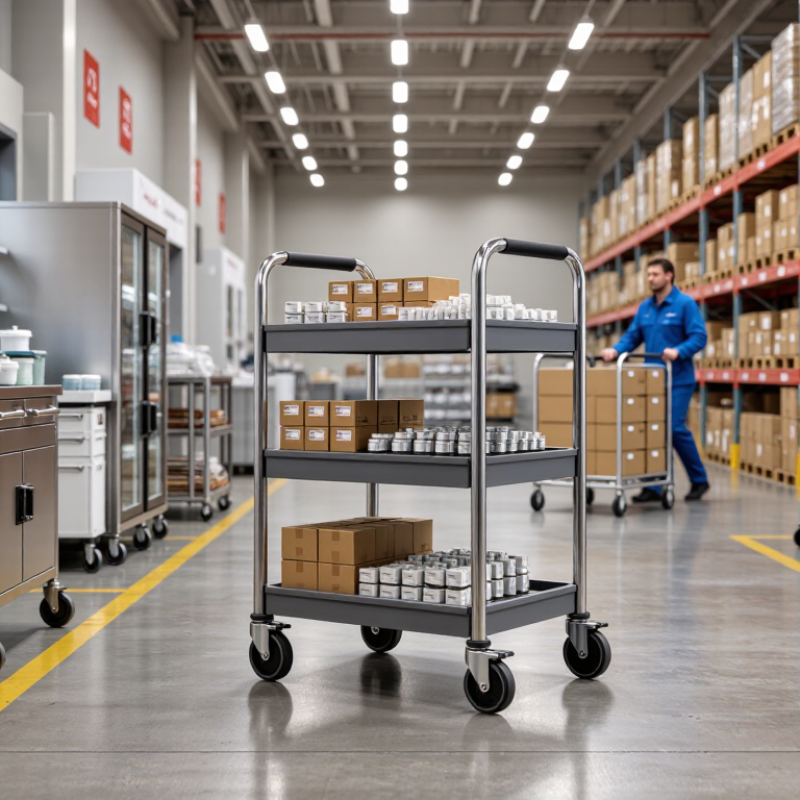
What Is a Material Cart and How Is It Used?

Definition and Core Features of a Material Cart

What Is a Material Cart and How Is It Used?

A material cart is a mobile storage and transport unit for moving tools, parts, containers, and supplies. It usually includes a steel or polymer frame, shelves, casters, and a push handle. Unlike a simple trolley, it often supports organized handling inside warehouses, workshops, laboratories, and production areas.

Core features determine how well the cart performs. Swivel casters help workers turn through narrow aisles, while fixed casters improve straight movement. Locking brakes keep the cart stable during loading. Shelves with raised edges reduce sliding, especially when the floor is uneven. A clearly stated load rating is essential because overloading can damage wheels or weaken the frame.

In practical use, workers may place labeled bins on separate shelves and keep heavier items near the bottom. This arrangement lowers the center of gravity and makes pushing easier. Smooth surfaces also simplify cleaning after dusty or oily tasks. That difference matters. A cart may look strong, yet small wheels can struggle over thresholds and floor joints.

Experienced operators check caster condition, handle joints, shelf fasteners, and brake performance before regular use. Some carts offer excellent capacity but poor visibility around corners. Others move easily but provide limited protection for fragile materials. Choosing the right design requires attention to load weight, aisle width, surface type, and cleaning needs. A perfect cart is uncommon; the best choice often reflects a careful compromise.

Main Types of Material Carts and Their Distinct Uses

A material cart is a wheeled tool for moving supplies, parts, and equipment safely. Its design affects speed, control, and worker comfort. In warehouses, workshops, hospitals, and production areas, carts reduce repeated lifting and unnecessary walking. A practical choice depends on load weight, floor condition, route length, and storage needs.

Platform carts have a flat deck for boxes, drums, and large equipment. They work well when workers need quick loading from a pallet or floor. Shelf carts provide two or more levels for smaller items. They keep tools visible and separate during maintenance tasks. Bin carts use removable containers for screws, fittings, and packaged components. Their labeled sections reduce picking mistakes, although poor labeling can still cause confusion. Cage carts add enclosed sides for loose or tall materials. They are useful when items must stay contained during movement.

Utility carts usually include a handle, shelves, and quiet casters for general indoor work. They suit cleaning supplies, paperwork, and light tools. Heavy-duty carts support dense loads, but their stronger frames can make turning harder. Towable carts serve longer routes in large facilities and need controlled towing speeds. In daily operations, staff should check caster condition, wheel locks, handle stability, and the rated capacity before use. A cart may appear convenient while being poorly matched to a narrow aisle. That mistake deserves review. Clear load placement also matters; heavy items should stay low, while fragile materials need restraint.

How Material Carts Support Workplace Transportation

A material cart is a wheeled unit designed to move supplies, tools, parts, or finished goods around a workplace. It reduces repeated lifting and keeps items together during internal transportation. In a storeroom, one cart may carry boxed components from receiving to production. Another may move maintenance tools between floors. Its value is practical: employees spend less time walking and more time completing assigned work.

Good cart use depends on matching the equipment to the task. Shelves help separate small parts, while raised sides prevent containers from sliding during movement. Swivel casters support tight turns, but uneven flooring can still cause instability. Load limits matter. Overloading makes steering difficult and increases strain on the person pushing. Clear aisles are essential, especially near doors, ramps, and shared work areas. It sounds simple. It is not always.

Work teams should inspect wheels, handles, brakes, and shelf connections before regular use. A damaged wheel may create extra noise, vibration, or sudden movement. Supervisors can improve reliability by assigning parking locations and checking whether carts block emergency access. However, a cart is not a complete solution. Poorly planned routes, rushed handling, and unclear loading practices can reduce its benefits. Periodic reviews help reveal these weaknesses. The best setup may need adjustment as materials, staff, or floor layouts change.

Typical Rated Load by Material Cart Type

How material carts support workplace transportation

Material carts are selected according to the load, handling environment, and movement distance. Platform and heavy-duty carts generally support larger loads, while shelf, wire, and panel carts are designed for organized transport of smaller or specialized materials. The values shown represent typical rated-capacity specifications commonly found in industrial material-handling equipment.

Key Factors for Selecting the Right Material Cart

What Is a Material Cart and How Is It Used?

A material cart moves tools, components, and finished goods between work areas. Workers use it in warehouses, factories, laboratories, and maintenance zones. The right cart reduces carrying distance and keeps loads organized. It can also limit awkward lifting and repeated walking.

Key Factors for Selecting the Right Material Cart

Start with the real load, not the estimated load. Check weight, dimensions, center of gravity, and loading frequency. A cart rated for 500 kilograms may still fail when tall boxes shift during turns. Wheel diameter matters on uneven floors. Swivel casters improve maneuverability, while fixed casters support straighter travel. Brakes are essential near ramps, doors, and production lines. Push handles should fit different users and encourage an upright posture. That detail is often overlooked.

The U.S. Bureau of Labor Statistics reported 888,100 private-industry cases involving days away from work in 2023. Material movement is not the only cause, but poor handling choices can increase exposure. The NIOSH Revised Lifting Equation also shows why load weight, reach distance, and frequency deserve careful review. Select shelves, bins, or platforms according to the actual workflow. Stainless construction suits washdown areas, while coated steel may suit dry facilities. Measure aisle width before ordering. The wheel test is often skipped. It should not be. A cart that moves well empty may become unstable when fully loaded. Review noise, maintenance access, turning space, and operator feedback before final selection.

What Is a Material Cart and How Is It Used? - Key Factors for Selecting the Right Material Cart

Data Dimension What It Means Typical Data or Options Selection and Usage Guidance
Definition A material cart is a wheeled platform, bin, rack, or trolley used to move, stage, store, or distribute materials. Common formats include platform carts, shelf carts, bin carts, panel carts, drum carts, and enclosed carts. Choose the cart format according to the material’s size, shape, weight, protection needs, and handling frequency.
Primary Uses Supports internal material movement and point-of-use organization. Transporting components, tools, boxes, totes, work-in-process items, waste, and packaged goods. Use carts to reduce manual carrying, shorten travel distances, and keep frequently used materials accessible.
Typical Work Areas Material carts are used in environments that require repeated, short-distance handling. Manufacturing floors, warehouses, maintenance areas, laboratories, workshops, retail stockrooms, and healthcare facilities. Verify that the cart’s materials and construction are compatible with the work area, floor condition, hygiene rules, and traffic pattern.
Load Capacity The maximum load the cart is designed to support under specified conditions. Light-duty carts may support loads below 250 lb; medium-duty carts commonly support about 250–750 lb; heavy-duty models may support more than 750 lb. Actual ratings vary by design. Select a rated capacity above the heaviest expected load and distribute weight evenly across the deck or shelves.
Cart Dimensions Overall length, width, height, deck size, shelf spacing, and usable storage volume. Compact carts suit narrow aisles; larger carts provide more capacity but require wider turning and parking space. Measure doorways, aisles, elevators, workstations, storage locations, and turning areas before purchasing.
Material of Construction The frame, shelves, deck, and enclosure materials determine durability, weight, cleanability, and resistance to the environment. Steel offers high strength; stainless steel supports corrosion resistance and cleaning; aluminum reduces cart weight; plastic resists many chemicals and does not rust. Match the construction material to moisture, chemicals, impact exposure, temperature, sanitation requirements, and required service life.
Caster Type Casters provide mobility and influence rolling resistance, maneuverability, floor protection, and stability. Swivel casters improve turning; rigid casters support straight travel; lockable casters help hold position; larger wheels generally roll more easily over uneven surfaces. Select wheel material and diameter based on floor type, debris, noise limits, load, temperature, and whether the cart must be moved frequently.
Handle and Ergonomics The handle height, grip, and pushing position affect operator comfort and control. Features may include vertical handles, push bars, padded grips, height-adjustable handles, and balanced load placement. Prefer pushing rather than pulling when practical, keep heavy items low, and select a handle that supports a neutral working posture.
Storage Configuration The arrangement of shelves, bins, drawers, dividers, racks, and retaining edges determines how materials are organized. Open shelves provide quick access; bins separate small parts; drawers protect contents; lips, rails, and straps help prevent items from falling. Choose open or enclosed storage according to access speed, contamination risk, security, item size, and spill control requirements.
Safety Features Safety features reduce unintended movement, falling loads, collisions, and operator exposure. Examples include wheel brakes, corner bumpers, guardrails, load-retention straps, non-slip surfaces, reflective markings, and rounded edges. Use brakes when parked, keep sightlines clear, avoid overloading, and follow site-specific traffic and manual-handling procedures.
Environmental Compatibility The cart must remain functional under the temperature, moisture, chemical, cleanliness, and static-control conditions of the workplace. Options may include corrosion-resistant surfaces, conductive or static-dissipative components, washdown-compatible construction, and temperature-rated wheels. Review chemical exposure, cleaning methods, humidity, temperature range, and electrical-control requirements before selecting materials and wheels.
Maneuverability Maneuverability describes how easily the cart starts, stops, turns, and travels through the intended route. Four-swivel-caster layouts turn easily; two swivel and two rigid casters provide directional stability; steerable or powered designs suit specialized applications. Evaluate aisle width, turning radius, slopes, thresholds, floor joints, congestion, and the cart’s loaded weight.
Maintenance Requirements Routine care preserves rolling performance, structural condition, cleanliness, and safe operation. Inspect casters, brakes, fasteners, handles, welds, shelves, wheels, and load-retention components; clean according to the surface and workplace requirements. Establish inspection intervals based on usage intensity and environment, and remove damaged carts from service until repaired.

Maintenance and Safe Operating Practices for Material Carts

A material cart is a wheeled platform used to move tools, parts, boxes, or supplies across a workplace. It reduces lifting strain and keeps materials organized during production, maintenance, or warehouse tasks. Before use, inspect the frame, handles, shelves, wheels, and brakes. Look for bent metal, loose fasteners, cracked welds, or debris around the casters. Test the brake on a level surface. Small faults can become serious during movement.

Load the cart evenly and keep heavy items on the lowest shelf. Never exceed its rated capacity, even for a short distance. Secure tall or unstable materials with straps so they cannot slide when the cart turns. Push rather than pull whenever visibility allows, and keep both hands on the handle. Move slowly near doors, ramps, wet floors, and blind corners. A spotter may help in crowded areas. Keep feet clear of the wheels.

Maintenance should follow the cart’s inspection schedule and workplace procedures. Clean dirt from casters and lubricate approved moving points when needed. Do not use damaged wheels as a temporary solution. Record defects and remove unsafe carts from service until a qualified person repairs them. In practice, rushed checks are easy to overlook. Even experienced workers sometimes miss a loose wheel before a busy shift. Slowing down for one careful inspection is worth the extra minute.
